Video CV for overseas jobs: what to change when the employer is in another country
A video CV for overseas jobs has to do something a local one does not: it has to work for a hiring manager who may be in another time zone, who hears your accent without the context of your country, and who cannot pop round to check what you said. Keep it short, speak slowly and clearly, name your job in the words the employer's country uses, say when you can talk, and point to proof of your work history that someone can check independently.
This guide is for candidates applying across borders, for example from Colombo, Manila, Nairobi or Lagos to an employer in Australia or New Zealand. It covers what to change, a simple structure, what to leave out and how to back the video up. If you are still deciding what to say, our guide to self-introduction video scripts has sample wording.
What changes when the employer is abroad
An employer in your own city can call you tomorrow, meet you next week and recognise the companies you name. An employer overseas usually does none of these. They watch your video once or twice, often between other tasks, and decide whether a call is worth arranging.
That shifts what the video is for. It does not need to prove your whole career. It needs to make a stranger confident that you communicate clearly, that your experience matches the role they are filling, and that the next step (a call, a reference check, a document) is easy.
- They cannot ask you to repeat yourself. Unclear audio or a rushed sentence is simply lost.
- They may not know your local job titles. "Site in-charge" or "mason" can mean different things in different countries.
- They cannot easily judge your employers. A company that is well known at home may mean nothing to them.
- They work to a different clock. A call at your lunchtime may fall in their night.
Fix the sound and the picture first
Employers forgive a plain background. They rarely forgive a video they cannot hear. Before you think about wording, record a short test, play it back on a different device and listen with the volume at a normal level.
Check these points:
- Record in a quiet room. Fans, traffic and a television in the next room all compete with your voice.
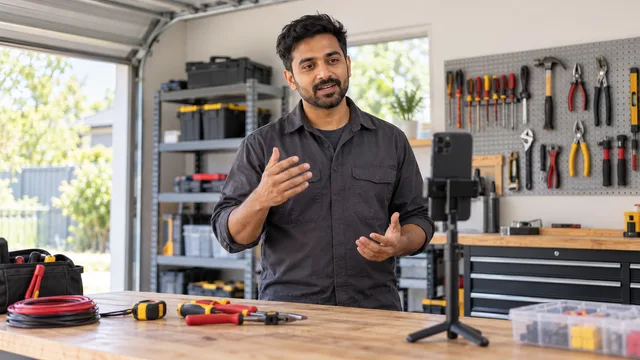
- Hold the phone upright at eye level, lens near your eyes. A phone resting low on a table looks up your chin.
- Face a window or a lamp, not the light behind you. A bright window behind your head turns you into a silhouette.
- Wear what you would wear to a site meeting or interview in that trade. Work clothes are fine for a trade role.
- Keep the frame simple: shoulders and head, nothing personal on the wall behind you.
Speak so a listener from another country can follow
You do not need to change your accent and you should not try. What helps is pace and shape. Many people speak faster on camera because they are nervous, and a listener working in their second or third language of the day needs a slower rhythm than a friend would.
- Use short sentences. One idea, then a pause.
- Say numbers and years plainly, and say each one once.
- Avoid local slang and abbreviations, including the names of local schemes or exams, unless you explain them in a few words.
- Name the country when you name a place. "I worked on road crews in Kandy, Sri Lanka" tells the listener more than "in Kandy".
Translate your job title, not your history
Your title in the video should match how the employer's country names the work, as long as it is honest. If you led a small crew of electricians but never held the formal title of foreman, say "I led a crew of electricians" rather than choosing a bigger-sounding title. The same advice applies in your written CV, and it matters more once someone starts checking.
A quick way to do this: take the job advert you are answering, find the title and two duties, and say your own experience using those words where they are true. Where they are not true, leave them out. Our guide to why overseas experience sometimes does not get an interview explains how employers read unfamiliar titles.
A simple structure that fits one short take
Plan the video as a short list of beats and write each as a sentence or two. Do not read a script word for word: it sounds flat, and your eyes move.
- Name and role. Your name, the job you are applying for and the country you are in now.
- Experience in one sentence. How long you have done this work and the kind of site, workplace or customer you did it for.
- One specific example. A job you completed, a process you ran or a problem you fixed, in plain words and without invented figures.
- Availability and time zone. "I am in Sri Lanka, so I can speak at the start or end of your working day." Do not promise a start date you are unsure of.
- Next step. Tell the viewer where to find your CV and evidence, and thank them.
The table below turns the structure into a checklist you can use after each recording.
| Part of the video | What it does for an overseas employer | A good sign when you replay it |
|---|---|---|
| Name, role, country | Tells them who you are and where to place you in time and distance | You said the role in the advert's words |
| Experience summary | Lets them match you against the job quickly | One clear sentence, no list of every employer |
| Example of your work | Shows how you explain a task to someone outside your workplace | A listener could repeat it back |
| Availability and time zone | Removes a barrier to scheduling a call | You named your country, not only a clock time |
| Where to find proof | Gives them a way to check what you said | The proof is attached or linked, not promised |
What to leave out
Some content that feels natural at home causes problems across borders.
- Visa claims. Do not say you "will get" or "are eligible for" a visa. You cannot know that, and an employer who hears it may wonder what else is guesswork. If your work rights matter to the role, state the plain fact in your written application and leave the rest to the employer and the official process.
- Personal details. Home address, ID numbers and anything from a passport or identity card do not belong in the video or on screen behind you.
- Criticism of past employers. It is hard to judge from a distance, and it can look like a reason someone will not give you a reference.
- Edited or enhanced footage that changes what is shown. If you ever submit video as part of a visa application, Home Affairs says applicants must provide genuine, verifiable and unaltered documents and information, including photographs, videos or audio files. A plain, honest recording is the safest habit for every purpose.
Back the video with proof someone can check
A video shows how you communicate. It does not show that your claims are true, and a careful overseas employer knows the difference. The strongest applications pair the recording with documents and people who can confirm the work.
Home Affairs lists examples of evidence of skilled employment for some visas, including employment references, contracts and payslips. Employers hiring from overseas often ask for similar records even when no visa step is involved. Our guides to which documents really prove work experience and to proving overseas experience explain what each record does and does not show.
Two practical points about documents you show or send:
- Cover sensitive details. Trades Recognition Australia asks applicants to delete or cover information such as a Tax File Number or bank account details before providing documents. The same habit protects you when an employer or recruiter sees your papers.
- Do not wave papers at the camera. The text will be unreadable and you may expose details you meant to hide. Describe the document in a sentence and attach a clear scan separately.
Also tell your referees that an overseas employer may contact them, and agree a convenient time. A reference that is easy to reach often settles the question faster than another document. If an old employer is slow to answer, other ways to prove you worked there are worth preparing early.
One option is a Talent Tabloid candidate profile (see its features), which can hold a short intro video next to your work history, with work videos and links as evidence the employer judges for themselves. Candidates moving abroad can read how it works on the page for global migrants. A video on a profile does not certify anything, and an employer will still want to check the work history through its own steps.
This guide is general information, not legal advice. Rules can change: check the official government website, or get advice for your situation, before you act.
Common mistakes
- Recording once and sending the first take. Replay it with the sound on and check the opening. If it is weak, the viewer may not reach the end.
- Using a job title nobody outside your country uses. Add a few words that explain what you actually did.
- Leaving out your time zone. The employer then has to guess when to call.
- Making claims the documents cannot support. If the video says one thing and your payslips another, the video is what loses credibility.
- Reading from a script with your eyes moving. Practise the beats, not the sentences.
- Treating the video as a replacement for the CV. It is an addition. Our guide to video introductions for job applications covers what to do when an employer asks for one specifically.
Frequently asked questions
Should a video CV for overseas jobs be in English?
Use the language the job advert and the employer work in. For employers in Australia and New Zealand that is normally English, spoken at a pace you can keep steady for the whole recording, with an accent that is yours.
Do I need to mention my visa or work rights in the video?
It is better to keep visa statements out of the recording. Put any plain, accurate statement about your work rights in your written application, and leave decisions about eligibility to the employer and the official process.
How should I handle the time difference?
Say which country you are in and offer a window that suits both sides, such as the start or end of their working day. Mention it again in your cover message so the employer does not need to rewatch the video to find it.
Can I show my certificates or payslips on camera?
It is usually better not to. Papers held up to a camera are hard to read and may reveal details you would rather cover. Describe the document briefly and send a clear copy separately, with sensitive numbers covered.
Will a video CV replace a reference check?
No. A video shows how you speak and present your work, but employers who hire from overseas generally still want some independent way to confirm your history, such as a reference they can contact or records that match your CV.
Key takeaways
- Make the video short, clear and easy to hear: sound and a steady pace matter more than the background.
- Describe your job in the words the employer's country uses, but only where they are true.
- Name your country and a time window so the employer can plan a call.
- Leave out visa promises, personal ID details and salary talk.
- Pair the video with documents and referees that someone can check independently.