Hiring a welder? The tickets, test piece and referee questions that catch a weak hire early
If you hire a welder who looked good on paper but cannot hold a clean root run on pipe, you pay for it. Rework, failed inspections, wasted material and a project that slips behind schedule can all follow from one weak hire. The good news is that welding is one of the easiest trades to check properly, because the work itself can be tested. This hiring a welder checklist covers the tickets and qualifications to ask about, how to run a fair test piece, which questions to ask referees and the warning signs worth a second look.
Start with the work you actually need done
"Welder" covers very different jobs. A structural welder on a building site, a pipe welder on a gas line, a fabricator in a workshop and a maintenance welder on a mine site need different processes, positions and paperwork. Before you read a single CV, write down:
- Processes: MIG (GMAW), TIG (GTAW), stick (MMAW or SMAW), flux-cored (FCAW), or a mix.
- Materials: mild steel, stainless, aluminium, chrome-moly or others.
- Positions: flat and horizontal only, or vertical, overhead and fixed pipe.
- Thickness and joint types: sheet, plate or pipe; fillet or full penetration butt welds.
- Codes and inspection: whether the work must meet a particular welding standard and will be inspected or tested.
- Other skills: reading drawings, fit-up, cutting, grinding, and any site licences your workplace needs.
This short list becomes your screening sheet. It also stops a common trap: hiring a strong workshop MIG welder for a job that is really six weeks of overhead stick welding on site.
Tickets, qualifications and certificates to ask about
Welding paperwork comes in layers. Ask candidates to show each one that applies, and read what it actually covers.
Trade qualification
This is the candidate's trade training, such as an apprenticeship certificate or a fabrication or welding trade qualification from their country. It shows they were trained, but it does not prove what they can weld today.
Welder qualification tests
Many welders also hold a welder qualification certificate tied to a recognised standard, for example ISO 9606 in many countries, AS/NZS 2980 in Australia and New Zealand, or ASME Section IX in pipe and pressure work. These certificates are specific. Check:
- the process, material, position and thickness range it covers;
- the date of the test and whether the certificate needs regular confirmation from an employer to stay valid;
- who tested and signed it, and whether you can contact them.
A certificate for 6G pipe in stick does not cover TIG on stainless sheet. Match the certificate to the job sheet you wrote above.
Site licences and safety tickets
Depending on your workplace, you may also need tickets such as working at heights, confined space entry, hot work permits or a forklift licence. These are separate from the welding itself and are easy to confirm with the issuing body or training provider.
For more on checking certificates and licences, the guide on how to verify a tradesperson's experience walks through the paper trail step by step.
Run a fair welding test piece
The trade test is the strongest check you have. A good welder can show you in an hour what a CV cannot. Make it fair, so you are testing skill, not nerves or unfamiliar gear.
- Tell the candidate in advance what process, material, position and joint they will weld, so they can bring their own helmet and gloves if they prefer.
- Use the job's real work. If the job is vertical-up fillet welds on 10 mm plate, test that, not a flat butt weld on thin sheet.
- Give a short warm-up on a scrap piece to set up the machine, and let them adjust it themselves. Machine set-up is part of the skill.
- Watch the whole process, not just the result: preparation, fit-up, tack welds, interpass cleaning and safe habits.
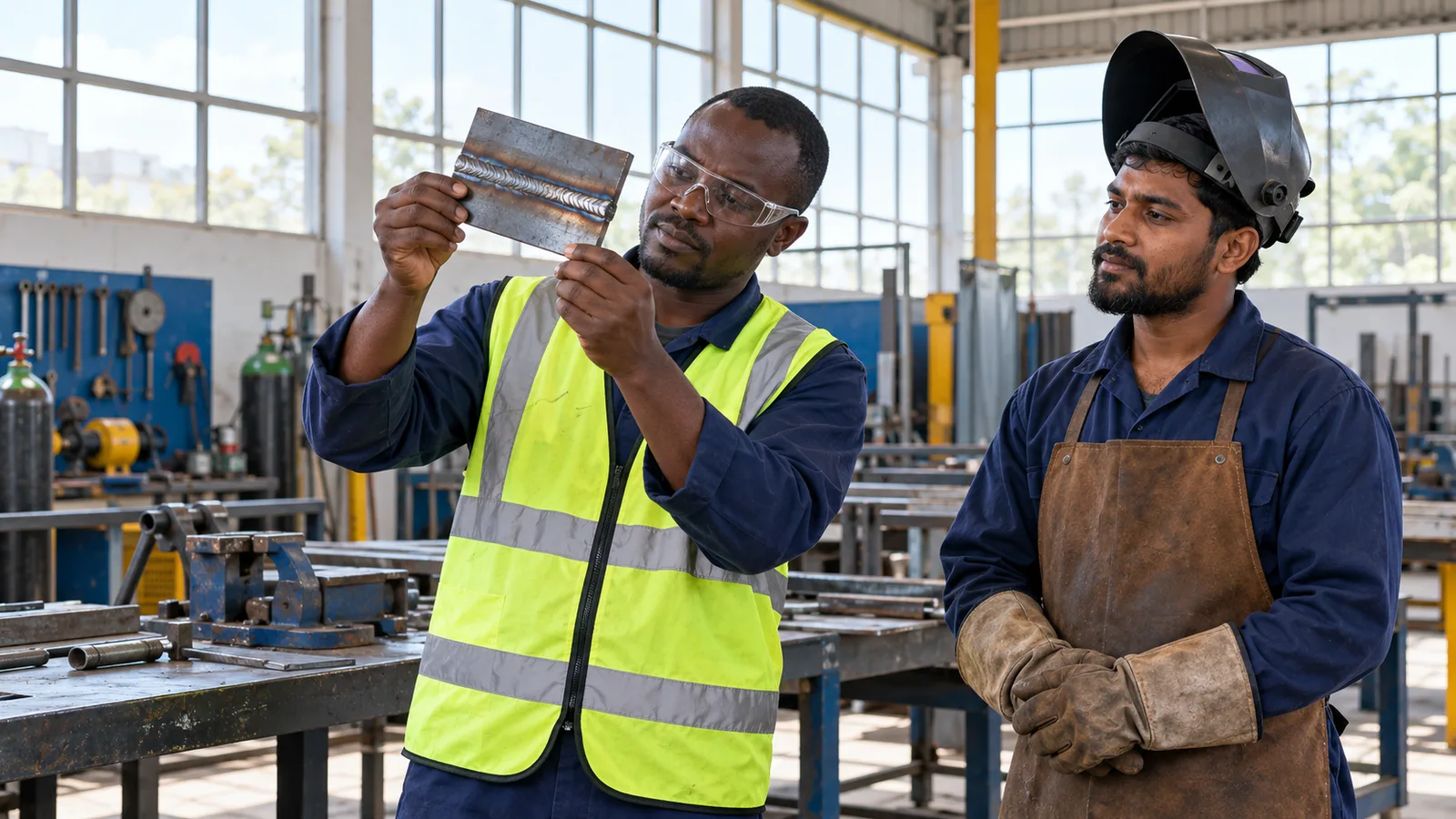
- Inspect the finished piece with the same eyes your inspector would: profile, undercut, porosity, spatter and penetration. For critical work, a cut-and-etch or bend test of the coupon shows what is inside the weld.
- Write down what you saw on a simple score sheet, so every candidate is judged the same way.
Example score sheet
This is an example; adjust it to your own work.
| What you check | What good looks like | Score (1-5) |
|---|---|---|
| Machine set-up | Sets amps, wire speed or gas flow without help | |
| Preparation and fit-up | Clean edges, correct gap, square tacks | |
| Weld appearance | Even profile, no undercut or visible porosity | |
| Penetration | Full fusion in a cut, etch or bend test | |
| Safety habits | PPE, fume control, tidy leads, fire watch where needed |
If you cannot test before hiring, for example when recruiting from overseas, ask for a recent video of the candidate welding in the relevant position, with their face visible at some point and the finished weld shown up close. The article on trade portfolio videos explains what makes a work video useful. A video is evidence, not a certificate, so treat it as a reason to test them on arrival, not instead of it.
What to ask a welder's referees
A supervisor who watched the candidate work can tell you things no test can: reliability, speed, how they handle rework and whether they follow procedures. Ask specific questions:
- "Which welding processes and positions did they use most in your workshop or site?"
- "Did their welds pass inspection or testing? How often did they need repairs?"
- "Did they read drawings and do their own fit-up, or work from someone else's set-up?"
- "How did they handle hot work permits and fire watch?"
- "Would you hire them again for the same work?"
More sample questions are in reference check questions for tradespeople. Always get the candidate's consent before contacting referees, and keep notes of what each referee said.
Warning signs worth a second look
None of these prove a candidate is dishonest. They are questions to ask before you decide.
- Every process and every position, all at expert level. Most good welders have strengths. A CV that claims everything may be copied from a job ad.
- Certificates that cannot be traced. No test date, no testing body, or a name that does not match the candidate's ID.
- No supervisor who watched them weld. Office or HR contacts can confirm dates but not skill.
- Reluctance to do a test piece for the exact work in the job.
- Work photos that do not match the claimed experience, such as only flat sheet work for a pipe welding role.
Some honest candidates, especially those trained overseas or on the job, have strong skills but thin paperwork. A fair practical test is the best way to give them a chance. The guide on proving trade experience without a certificate covers what other evidence can count.
Where Talent Tabloid fits
Talent Tabloid is a platform where candidates build a profile with their work history, qualifications, a video intro and work evidence in one link. Welders can attach work videos and photos to a skill, which gives you something to watch before you book a test.
In the employer dashboard, Search by Skill lets you describe the role in plain English, such as a pipe welder with TIG experience on stainless, and pick the work country. If a candidate gives you their username, you can look up their profile on the People Search page. Skill evidence on a profile is not certified: it is material for you to judge, and it does not replace your own test piece. You can see how the employer tools work on the employers page and create an employer account when you are ready.
A simple hiring a welder checklist
- Write the job sheet: processes, materials, positions, thickness, codes and site tickets.
- Screen CVs against that sheet, not against a general idea of "experienced welder".
- Ask for the trade qualification and any welder qualification certificates, and check what each covers.
- Confirm safety tickets and site licences with the issuing body.
- Run a fair test piece on the real job's joint and position, with a score sheet.
- Call at least one supervisor who watched the candidate weld.
- Record your results the same way for every candidate.
Frequently asked questions
Is a welding certificate enough to hire a welder?
Not on its own. A certificate shows what the welder passed on the day of the test, for a specific process and position. A practical test and a supervisor's reference show what they can do now.
How long should a welding test take?
Many employers plan an hour or two, including set-up and a short warm-up. Longer tests are fine for complex pipe or code work, as long as every candidate gets the same time.
Can I test a welder hired from overseas before they arrive?
You can ask for a recent video of them welding the joint you need and talk to a supervisor who saw their work. Plan a practical test on arrival as well, before they start on critical work.
Should I pay candidates for a trade test?
Practice varies. A short test piece is common, but if the test becomes real productive work, check your local employment rules on paying for it.