Practical trade test for hiring: run it badly and your strongest welder, electrician or mechanic may walk
A practical trade test for hiring should answer one question: can this person do the work you need, safely, to your standard? Run it badly and it answers a different one. A test that drags on for a whole unpaid day, changes from one candidate to the next, or is scored on gut feel can send a strong welder, electrician or mechanic to the employer down the road, and leave you hiring the person who simply coped best with a strange workshop.
This guide shows you how to design a fair skills test, score it the same way for everyone, keep it safe and lawful, and use it alongside references and work evidence instead of in place of them. Sample tests for three trades are included.
Decide what the test must prove before you book anyone
Start from the job, not from a favourite test piece. Write down the three to five tasks the new starter will do in their first month, then pick the one or two that are hardest to fake and quickest to show.
- Core skill: the task the job cannot run without, such as a fillet weld to your procedure, fault-finding on a circuit, or diagnosing a no-start.
- Safety habit: what they do before they start: checking equipment, isolating, wearing the right protection, reading the drawing.
- Quality check: whether they inspect their own work and say when something is wrong.
Leave out tasks the person will be trained on anyway, and anything your own team does differently every time. A test should measure skill, not whether someone guessed your house habits.
Match the test to the ad
If the ad asks for MIG welding on structural steel, do not test TIG on stainless. If the role is for servicing light vehicles, a heavy diesel rebuild tells you little. Candidates notice when a test has nothing to do with the job they applied for, and the good ones have other options.
Sample practical tests for three trades
These are examples to adapt. Times are guides for a focused demonstration, not a day of free labour.
| Trade | Sample task | Typical length | What a strong result shows |
|---|---|---|---|
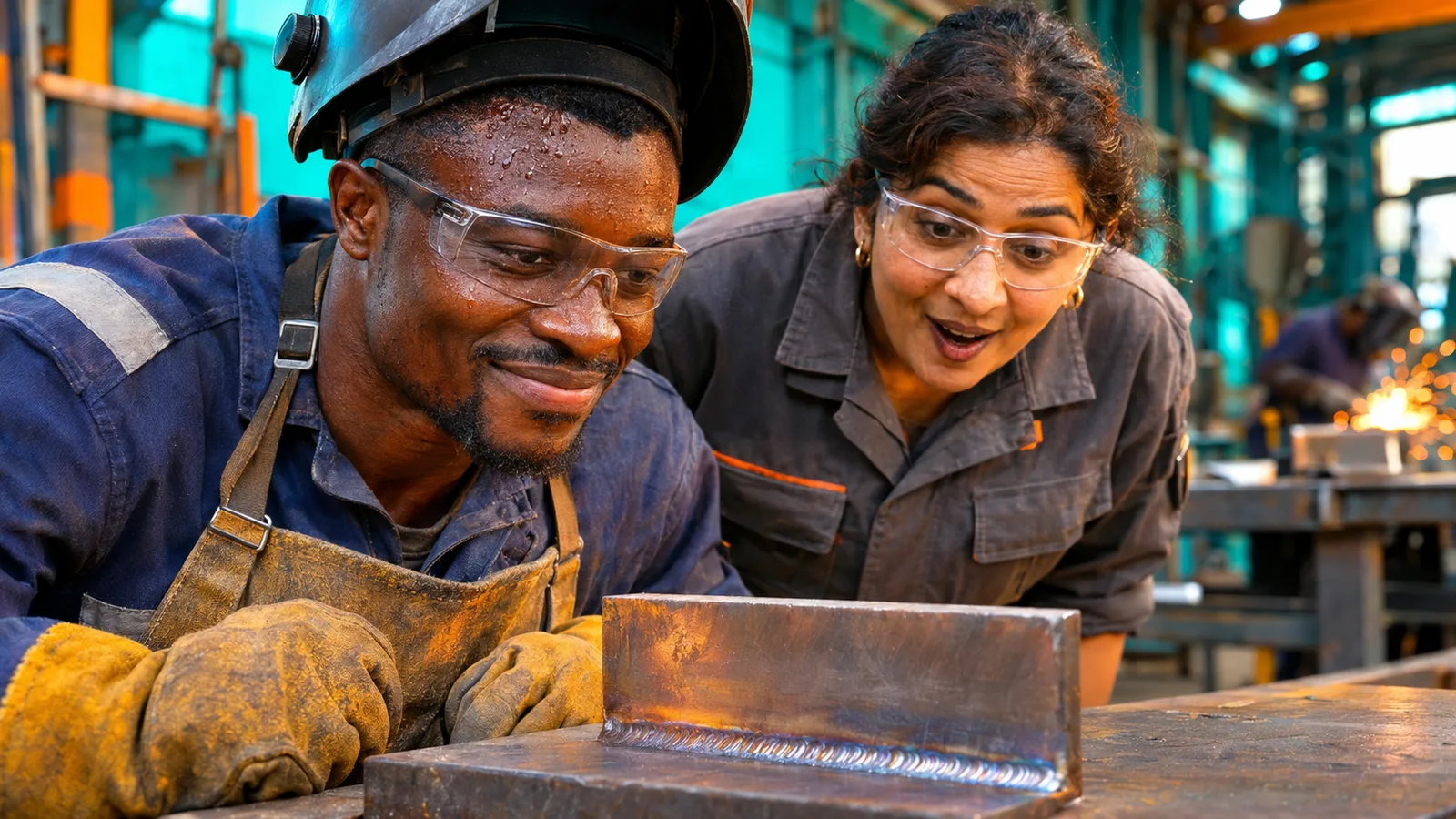
| Welder | Two test pieces to a written procedure, in the position the job needs | 1 to 2 hours | Preparation, consistent bead, clean finish, checks own work before handing it over |
| Electrician | Find and explain set faults on a de-energised training board | About 1 hour | Safe isolation steps, a logical fault-finding order, clear explanation of the fix |
| Mechanic | Diagnose a set fault on a workshop vehicle and write the job card | About 1 hour | Uses the scan tool and basic tests in order, does not swap parts at random, writes a readable card |
For welders, the post on tickets, test pieces and referee questions for hiring a welder goes deeper into the test piece itself.
Licensed work needs extra care
Some trades need a licence before a person can do certain work at all, and the rules differ by state and country. Design the task so it stays inside what the candidate is allowed to do: a training board instead of live circuits, a supervised task instead of signing anything off. Check the licensing body's own pages for the trade if you are unsure.
How to run a fair practical assessment, step by step
- Write the brief. One page: the task, the time allowed, the tools and materials provided, and what "finished" looks like. Every candidate gets the same page.
- Tell candidates in advance. Say what they will do, how long it takes, what to bring (boots, glasses, their own hand tools if you expect them) and whether it is paid.
- Do a short safety induction. Show exits, first aid, the equipment they will use and any site rules. Record that it happened.
- Use one assessor, or two with the same sheet. Swapping assessors between candidates is the fastest way to make scores meaningless.
- Score against a sheet, not a feeling. Three to five criteria, each scored 1 to 4 with a short description of what each score looks like.
- Let them talk. Ask "what are you checking now?" once or twice. How someone explains their work often tells you how they will train an apprentice later.
- Give a short debrief. Two minutes on what went well. It costs nothing and leaves the candidate with a good view of your business, whatever the outcome.
A simple scoring sheet
Example: a fictional fabrication shop hiring a welder scores four criteria from 1 (not shown) to 4 (to standard without help): preparation and set-up, safety habits, weld quality against the procedure, and self-inspection. A candidate needs at least 3 on safety to go further, whatever their other scores. Writing that rule down before the test stops a great-looking weld from hiding a careless habit.
Paid or unpaid: keep the test short and lawful
In Australia, the Fair Work Ombudsman explains that an unpaid work trial may be unlawful when it is not needed to show the skills for the job, runs longer than needed, involves more than a demonstration of skills, or the person is not directly supervised. Its page on unpaid trials gives examples, and any time beyond what is reasonably needed must be paid at the right minimum rate. Other countries have their own rules, so check the official employment pages where you hire.
In practice that means:
- Keep the test to the demonstration itself, usually an hour or two.
- Never put the candidate on a paying customer's job during an unpaid test.
- Supervise the whole time.
- If you want to see more, offer paid casual work or a probation period instead of a longer free trial.
Testing candidates who are not local yet
Overseas and interstate tradespeople cannot always walk into your workshop next week. You can still narrow the field before anyone travels.
Look at work evidence first
Before you book a test, ask for the candidate's Talent Tabloid profile link: work videos can be linked to a specific skill, so you can see hands-on work before choosing what to test. That evidence is not certified on Talent Tabloid: the videos, photos and links are evidence you judge for yourself. Use what you see to decide which task in your test matters most, and ask about anything unclear on a video call. The post on what a 60-second trade work video should show explains what useful footage looks like.
Then test in person
A video shows what someone has done; your test shows what they can do in your conditions. Keep the in-person test for the shortlist, and plan it for the first days after arrival if the role allows. The post on hiring overseas tradespeople you cannot watch work covers the steps before that point.
Use the result with references, not instead of them
A good test shows skill on one day. It does not show reliability, attendance or how someone works with a team over months. Follow a strong test with reference questions about the same skills; the post on reference check questions that test the work has examples. Employers on Talent Tabloid can move candidates through pipeline stages such as To Review, Interviewing and Offer Sent, so test results sit alongside the rest of the shortlist.
Common mistakes that make a trade test unfair
- Changing the task between candidates. Scores stop being comparable.
- Unfamiliar equipment with no time to adjust. Give a few minutes to set up a machine they have not used.
- Testing speed when the job needs accuracy. Score what the job actually rewards.
- Judging accent or confidence instead of the work. A quiet candidate with a clean, safe result has passed the test you set.
- No record. Keep the scoring sheet and brief. If a candidate asks why they were not chosen, you can explain fairly.
Hiring tradespeople this month? Create an employer account to look at candidate profiles and work evidence before you set your test, or read more on the employers page.
Frequently asked questions
How long should a practical trade test be?
Long enough to see the core skill, and no longer. For most trades that is an hour or two; anything beyond what is needed to show the skill should be paid.
Should every candidate get the same test?
Yes. Same brief, same materials, same time and the same scoring sheet. Otherwise you are comparing different tests, not different people.
Can a work video replace a practical test?
It can help you shortlist and choose what to test, but it does not show how someone works in your conditions. Use both where you can.
What if a candidate fails on safety but the work looks good?
Treat safety as a must-pass and decide that before the test. Good-looking work done unsafely is a risk on every future job.